Workplace wellness is no longer a passing trend or a marketing argument to attract talent. It has become a strategic imperative that executives and human resources managers can no longer ignore. In an economic context marked by the war for talent, the generalization of hybrid work, and a collective awareness around mental health, companies that seriously invest in the well-being of their employees are reaping tangible and measurable benefits.
According to the World Health Organization, workplace well-being is defined as a state of mind characterized by a satisfying harmony between the skills, needs, and aspirations of the worker on one hand, and the constraints and possibilities of the work environment on the other. This definition highlights the importance of a subtle balance between individual expectations and organizational realities. In 2026, this balance inevitably involves integrating regular physical activity into the professional daily routine.
The figures are eloquent and should convince even the most skeptical decision-makers. Companies that have implemented structured sports and wellness programs are observing a reduction in absenteeism reaching up to twenty percent. This decrease is explained by an overall improvement in the physical health of employees, who become less prone to sick leave related to chronic stress, musculoskeletal disorders, or persistent fatigue. In parallel, productivity increases significantly, with average gains of fifteen percent observed in organizations that have adopted an ambitious wellness policy.
The main reason behind these improved performances lies in the physiological and psychological effects of regular physical activity. When an employee practices sports regularly, their body releases endorphins, these well-being hormones that provide a sensation of pleasure and relaxation. This natural chemical release considerably reduces cortisol levels, the stress hormone, which when produced in excess can lead to anxiety, sleep disorders, and decreased concentration. An employee who is less stressed is naturally more focused, more creative, and more effective in executing their daily tasks.
Beyond individual benefits, corporate sports play an essential unifying role for team cohesion. Collective sports sessions create unique moments of conviviality that allow employees from different departments to meet outside the strictly professional framework. These informal interactions foster the development of authentic relationships, strengthen team spirit, and contribute to establishing a positive and dynamic company culture. An employee who feels integrated and connected to their colleagues develops a stronger sense of belonging, which translates into increased engagement and a willingness to actively contribute to collective success.
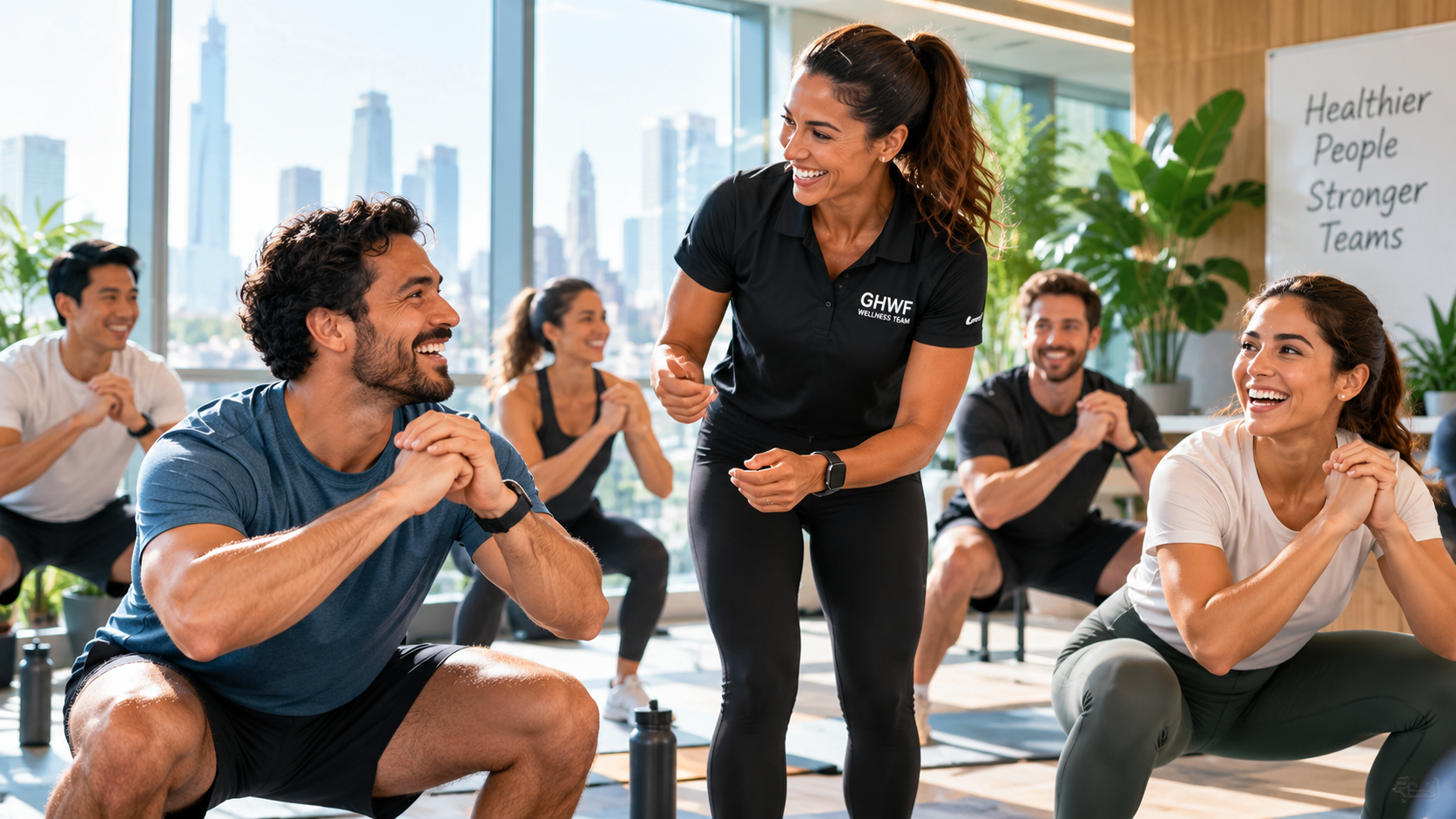
Corporate sports formats have evolved considerably in recent years to adapt to the new realities of the professional world. Modern companies are now adopting hybrid approaches that combine several modalities to maximize engagement and inclusion. On-site group classes remain extremely popular, particularly for teams of twenty employees and more. These group sessions, generally led by certified and experienced fitness coaches, accommodate between eight and twenty participants and constitute an excellent team-building lever. The physical presence of a qualified professional guarantees the quality of movements, prevents injury risks, and maintains collective motivating energy throughout the session.
The on-demand digital platform represents the other indispensable pillar of a complete wellness program in 2026. This modality responds perfectly to the challenges posed by the generalization of hybrid work and remote work. Employees who are not physically present in the offices can thus access a complete library of workouts at any time, from their home or their remote work location. This flexibility ensures that no one is excluded from the program, regardless of schedules, geographic location, or personal constraints. The best platforms offer varied content covering numerous disciplines, from yoga to strength training through cardio and stretching, with sessions adapted to all levels, from complete beginner to confirmed athlete.
Connected challenges constitute a third particularly effective modality for maintaining engagement over the long term. By introducing a healthy playful and competitive dimension, these gamified devices transform sports practice into a motivating and addictive experience in the good sense of the term. Employees can challenge each other among colleagues, track their personal progress, unlock achievement badges, and participate in departmental rankings. This approach responds to a fundamental need for recognition and accomplishment, while creating collective emulation beneficial to the entire organization.
Thematic wellness workshops complete this ecosystem by bringing an educational and preventive dimension. These sessions can cover varied topics such as stress and emotion management, workplace ergonomics to prevent musculoskeletal disorders, balanced nutrition adapted to professional constraints, or even breathing and meditation techniques to improve sleep quality. These workshops position the company as a responsible and benevolent actor, concerned with the overall health of its employees beyond mere economic performance.
The return on investment of a well-structured corporate sports policy goes far beyond the simple improvement of individual well-being. Human resources now have quantified data to convince the most reluctant executive committees. The reduction in absenteeism generates substantial direct savings, particularly in countries where sick leave is partially or fully covered by the employer. The decrease in turnover also represents a major financial gain, knowing that the cost of replacing an employee is generally estimated between six and nine months of gross salary. A company that succeeds in retaining its talent thanks to an attractive well-being policy therefore achieves significant structural savings.
Employer attractiveness constitutes another weighty argument in a tight labor market where candidates have choices. Recent studies show that more than sixty-seven percent of active candidates consider well-being programs as a decisive factor in their choice of employer. Platforms like Glassdoor, LinkedIn, and professional social networks massively relay positive initiatives regarding quality of life at work, thus contributing to strengthening the employer brand in an organic and authentic manner. A company recognized for its commitment to well-being naturally attracts quality profiles and significantly reduces its recruitment costs.
GlobalHub Wellfit positions itself as a privileged partner for companies wishing to deploy an ambitious and effective sports and well-being program. Unlike many fitness applications powered by artificial intelligence offering generic and impersonal content, our platform resolutely prioritizes human expertise with certified coaches and international-level athletes. This approach guarantees exceptional coaching quality and a premium user experience that clearly distinguishes itself from standardized market offerings.
Our platform adapts with great flexibility to all company sizes, from ten-employee start-ups to large groups of one hundred thousand employees and more. This scalability is based on robust and secure technological architecture, compliant with the most demanding regulations such as the European GDPR. Programs start at less than one hundred UAE dirhams per employee, which represents an accessible investment even for small and medium-sized enterprises, with modular options including on-demand access, on-site classes, thematic workshops, and a complete analytical dashboard for human resources teams.
The HR dashboard constitutes one of the major assets of our solution. It allows managers to track employee engagement in real time, identify the most popular disciplines, measure participation rates by department or geographic location, and generate personalized reports for the executive committee. This objective data greatly facilitates informed decision-making and allows continuous program adjustment to maximize its impact and return on investment.
Our client testimonials speak for themselves and illustrate the concrete transformation that our platform enables. Jason L., company founder, testifies that collaborating with GlobalHub WellFit has been truly transformative for his organization. Sarah M., fitness enthusiast, explains having joined our platform with the objective of maintaining regular sports practice and having exceeded all her initial expectations. Priya B., certified counselor, highlights the quality of personalized calls and tailored training programs that were proposed to her. Daniel C., behavioral specialist, emphasizes that the best asset of our coaching lies in the absence of necessity to go to a gym, making practice accessible to everyone.
The implementation of a corporate sports program should not be perceived as a superfluous expense or an accessory benefit, but rather as a full-fledged strategic investment with a clearly identifiable and measurable return on investment. Companies that understand this stake today take a significant competitive advantage in terms of attractiveness, talent retention, and organizational performance. Those that delay tackling the subject risk being progressively overtaken in the war for talent and suffering the consequences of uncontrolled absenteeism and costly turnover.
If you wish to implement an ambitious and effective sports well-being program in your company, contact GlobalHub Wellfit now to benefit from a free personalized audit. Our team of experts will accompany you in designing an offer perfectly adapted to the culture, needs, and specific constraints of your organization. Together, we will durably transform the quality of working life of your teams and generate tangible benefits for your overall performance.